How to Automate Apartment Social Media With AI

Contents
You can hand almost all of apartment social media to AI: planning the month, drafting captions, picking photos from your own library, choosing times and publishing. Keep one step for a person, which is deciding what goes out. That one approval is where the risk sits: fair-housing language, facts about your property, and anything that looks like a review or a promise.
This guide sorts the work into what to automate and what to keep, then walks through an approve-first setup and the platform rules that shape it.
What parts of apartment social media can AI do?
Most of the repetitive work, as long as it works from your facts. The table below is the split we'd use for any tool, ours included.
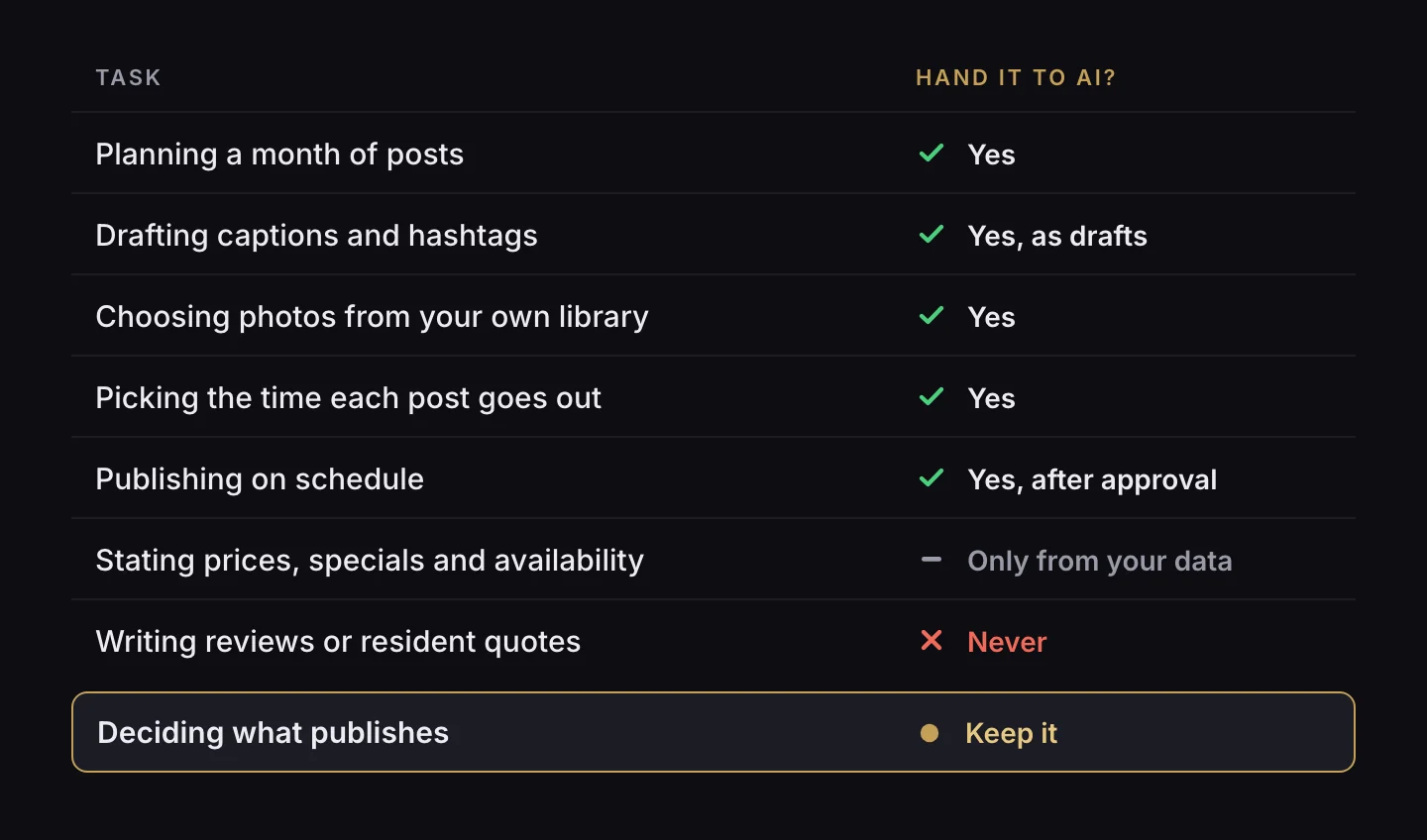
| Task | Hand it to AI? | Why |
|---|---|---|
| Planning a month of posts | Yes | A mix of post types across the month is a pattern, and pattern work is what software is good at |
| Drafting captions and hashtags | Yes, as drafts | The draft is fast to read and easy to correct |
| Choosing photos from your own library | Yes | Your photos are real; the risk is only in which one goes with which caption |
| Picking the time each post goes out | Yes | Nobody needs to decide that by hand every day |
| Publishing on schedule | Yes, after approval | Once a person has said yes, the clock can do the rest |
| Stating prices, specials and availability | Only from your data | A wrong price or a promise you can't keep is the costliest mistake a post can make |
| Writing reviews or resident quotes | Never | The FTC's rule on fake reviews names AI-generated ones |
| Deciding what publishes | Keep it | That's the approval step this guide is about |
Why keep a person in the loop?
Because your community is responsible for what it publishes, however the words were written. Three rules make that concrete.
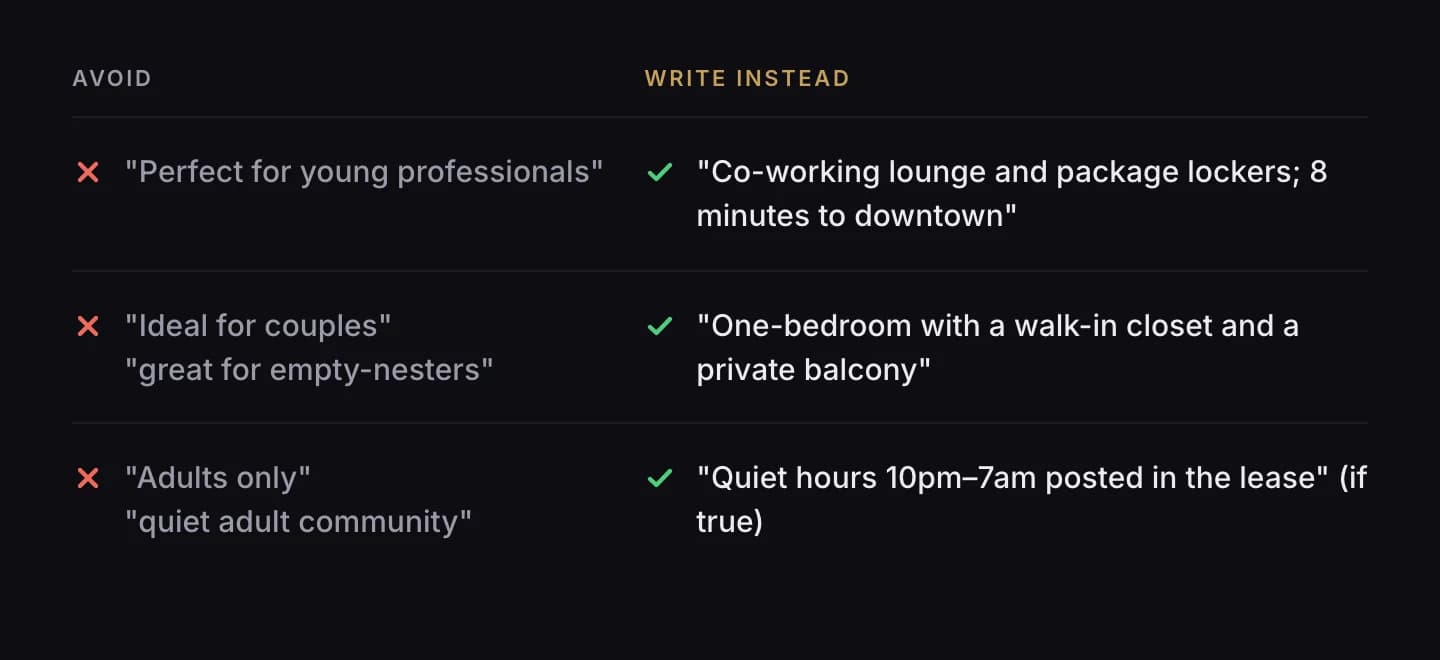
Fair housing. The Fair Housing Act reaches anyone who will "make, print, or publish, or cause to be made, printed, or published" a housing ad that indicates a preference or limitation based on a protected class. If an AI tool writes "perfect for young professionals" and your page posts it, your page published it. Our fair housing rules guide has the phrases to watch and the rewrites.
Fake reviews. The FTC's final rule on fake reviews and testimonials (16 CFR Part 465, announced August 14, 2024) says it will deter AI-generated fake reviews. An AI tool that invents a "resident" saying they love the gym is producing exactly what that rule is about. Real reviews, shared with permission, are fine.
Platform rules. Each network has its own limits on automated posting, and some of them change what a tool can do for you (see the platform section below).
How do you set up an approve-first workflow?
Give the AI your facts, let it draft the whole month, and review the month in one sitting. Reviewing one post at a time, every day, is how approval quietly turns into no approval.
- Start from your own facts. The community's website, floor plans, amenities, policies and photos. A tool that drafts from a prompt alone will fill gaps with guesses, and guesses about a property are how a post ends up promising a pool you don't have.
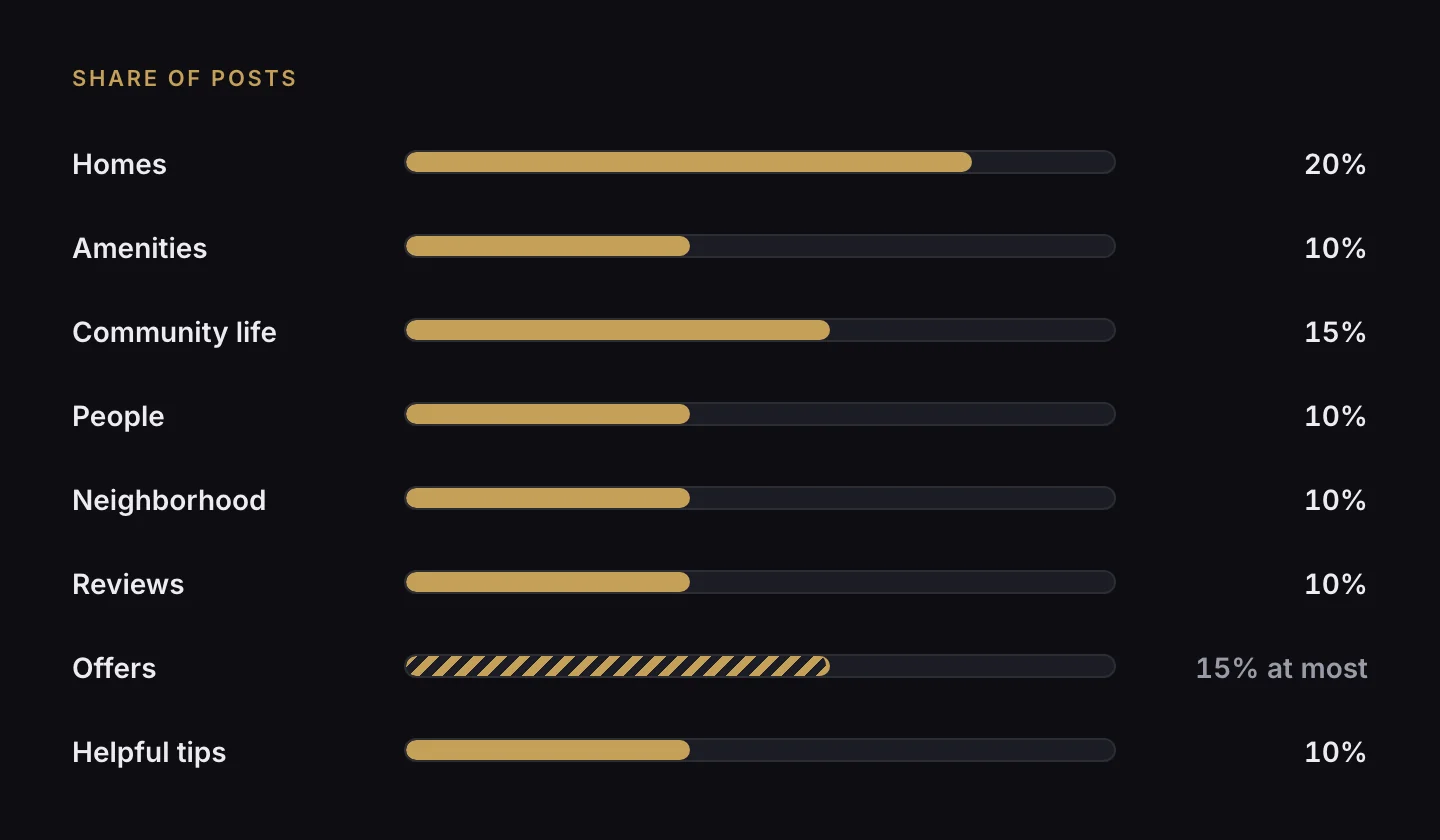
- Set the mix, not the posts. Decide roughly how much of the month goes to homes, amenities, community life, the neighborhood and offers. Our 36 apartment social media post ideas sorts post types by goal and gives a starting mix.
- Let it draft the month at once. A full month in one batch is easier to judge than a trickle: you can see repeats, gaps and anything that sounds off next to the rest.
- Read every draft once. Check the facts (price, dates, what's available), the language (describe the home, never the kind of person), and the people in any images (look at them as a set across the month).
- Approve, and let the schedule run. After that, publishing is just a timer.
- Look at what happened next month. Which posts got saves, clicks and messages? Feed that into the next month's mix.
Which platform rules affect automated posting?
The big ones are posting limits, private-only rules for new apps, and branding. These come from each platform's own developer documentation, read in October 2026:
- Instagram limits each professional account to 100 posts published through its API in a rolling 24 hours. A carousel counts as one post and holds up to 10 images, videos or a mix.
- TikTok restricts apps that haven't passed its audit: content posted through them is private, the posting account must be private, and only five users can post through such an app in a day. TikTok also says apps should not add their own "brand name, logo, watermark" to content shared there.
- Google Business Profile posts can be updates, offers or events, and they appear on your profile in Search and Maps.
None of this stops you automating. It does mean the tool you pick should know these rules, rather than you finding out from a rejected post.
What should you never automate?
- Facts you haven't given it. Prices, specials, move-in dates and amenities come from your data or not at all.
- Testimonials. Share real reviews with permission; never generated ones.
- Replies in a crisis. A complaint about safety, a leak or a neighbor dispute gets a person, not a template.
- The final yes. It's the step that protects the community.
How Lease Velocity automates it
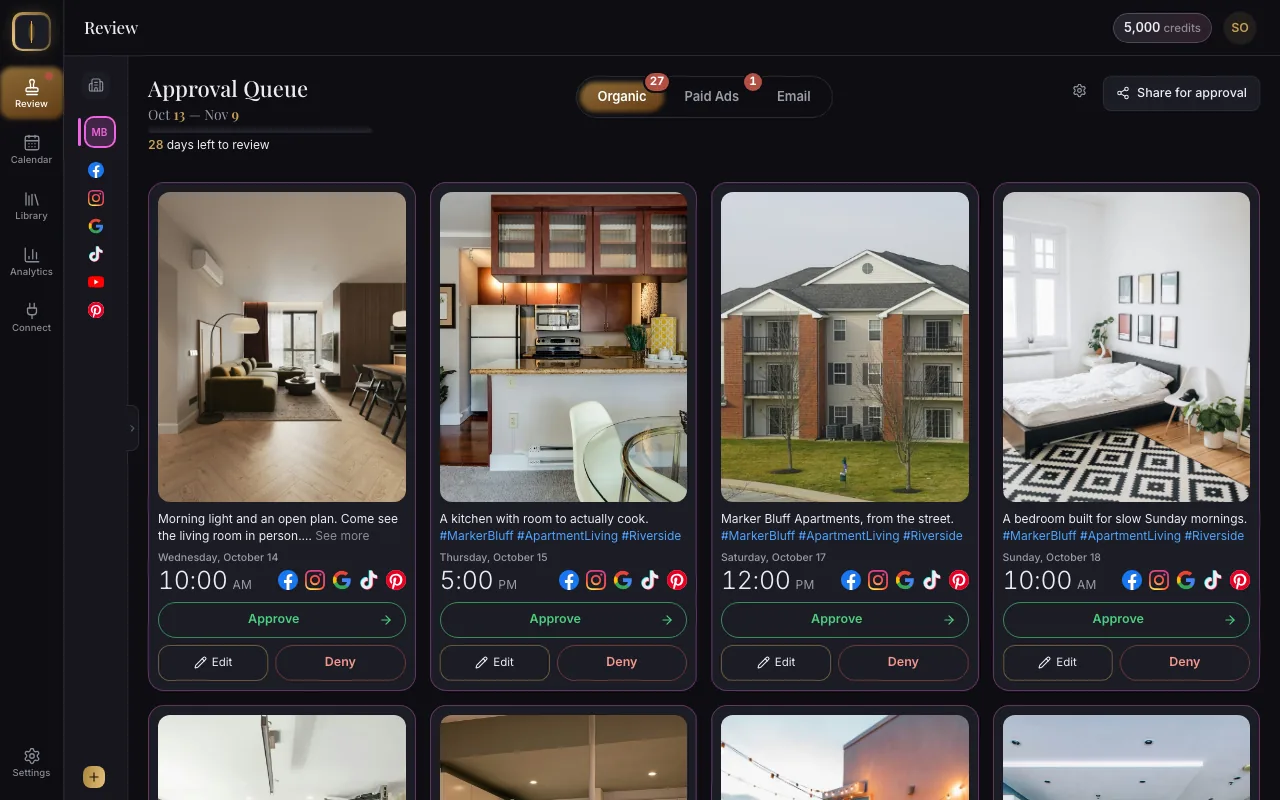
Lease Velocity is AI marketing for apartment communities, built on this approve-first split. You paste your website address and Lease Velocity reads the property — the name, the description, the amenities on the page, your photos, your contact and policy details. From there it writes the posts and puts them on a calendar. A generated post is a draft until you approve it, and only an approved post with a time on it ever publishes. If a post carries a phrase the fair-housing check treats as a violation on its face, the publish step refuses it and records why. Lease Velocity plans and schedules posts for Facebook, Instagram, Google Business Profile, TikTok, YouTube and Pinterest, and sends email.
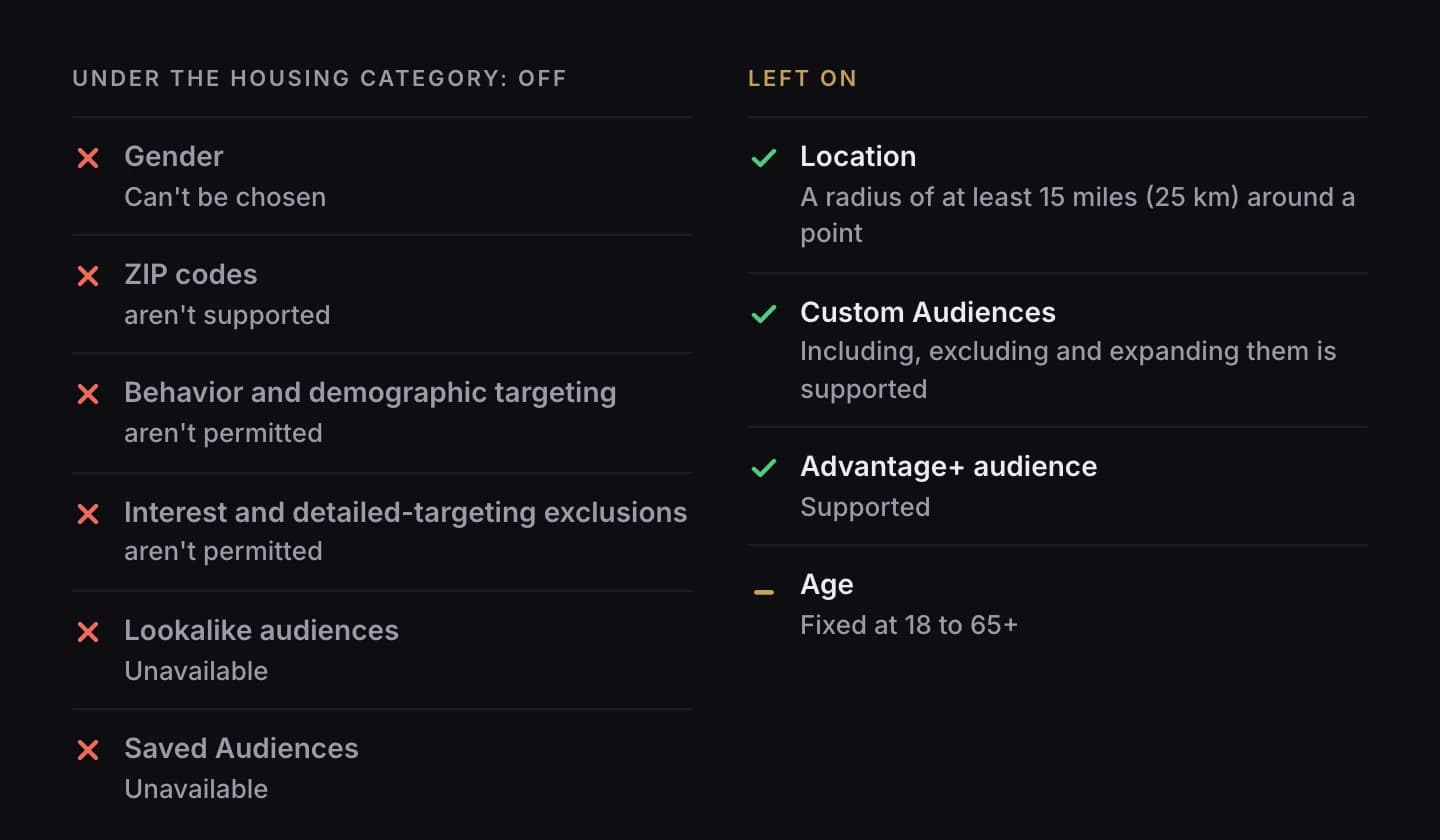
For the paid side, see what Meta's Housing category lets you target.
Sources (fetched 2026-10-12)
- Meta for Developers, "Content Publishing" (Instagram Platform).
- TikTok for Developers, "Content Sharing Guidelines".
- Google Business Profile Help, "Create & manage posts on your Business Profile".
- Federal Trade Commission, "Federal Trade Commission Announces Final Rule Banning Fake Reviews and Testimonials", August 14, 2024.
- 42 U.S.C. §3604, Legal Information Institute, Cornell (fetched 2026-10-07).
Related
Lease Velocity