Facebook and Instagram Housing Ads: What You Can Target

Contents
An ad for an apartment on Facebook or Instagram is a housing ad, and Meta requires it to run under its Housing Special Ad Category. That category fixes the age range at 18 to 65+, takes away gender, ZIP-code, behavior and demographic targeting, sets a minimum radius of 15 miles in the US, and switches off lookalike audiences. What you have left is geography, audiences you built from your own sources, and Meta's automated audience. So the ad itself has to do most of the work that targeting used to do.
This guide covers what the category is, what it leaves you, how to set a campaign up, and the mistakes that get housing ads rejected.
What is Meta's Housing Special Ad Category?
It's a declaration you make on every campaign that advertises housing, and it limits the targeting you can use. Meta's advertising policy says advertisers in the United States, and advertisers whose ads reach the US, Canada or parts of Europe, must self-identify as a Special Ad Category when they run housing, employment or financial-products ads, and must use only the targeting options Meta approves for them.
The declaration lives at the campaign level. Meta's developer documentation says "All campaign creations require the special_ad_categories field", even when the answer is "none". For a community advertising homes for rent, the answer is Housing.
There is no size threshold. A boosted post about a two-bedroom that's available next month is a housing ad, the same as a full campaign built in Ads Manager. The rules attach to what the ad is about, not to the button you pressed to create it.
Why does Meta limit targeting on housing ads?
Because ad targeting was used to keep people from seeing housing, and the Fair Housing Act covers where you advertise as well as what you say. HUD's regulation at 24 CFR §100.75(c)(3) names "selecting media or locations for advertising" that deny particular groups information about housing. Meta's own policy says advertisers may not use its audience tools to "wrongfully exclude specific groups of people" from seeing their ads.
The current rules also have a court record behind them. In United States v. Meta Platforms, the Justice Department alleged that Meta's ad system discriminated in delivering housing ads. Under the settlement approved on June 27, 2022, Meta stopped using its "Special Ad Audience" tool for housing and built a new delivery system.
That system is the Variance Reduction System, which Meta announced on January 9, 2023. For US housing ads, it compares the age, gender and estimated race or ethnicity of the people who actually saw an ad with the audience that was eligible to see it, and it adjusts delivery when the two drift apart. In practice, your ad is shown to a broad audience on purpose.
What can you target in an apartment ad?
Location, your own Custom Audiences and Meta's Advantage+ audience. Most of the rest is off. This is what Meta's Special Ad Category documentation lists for housing ads in the US:
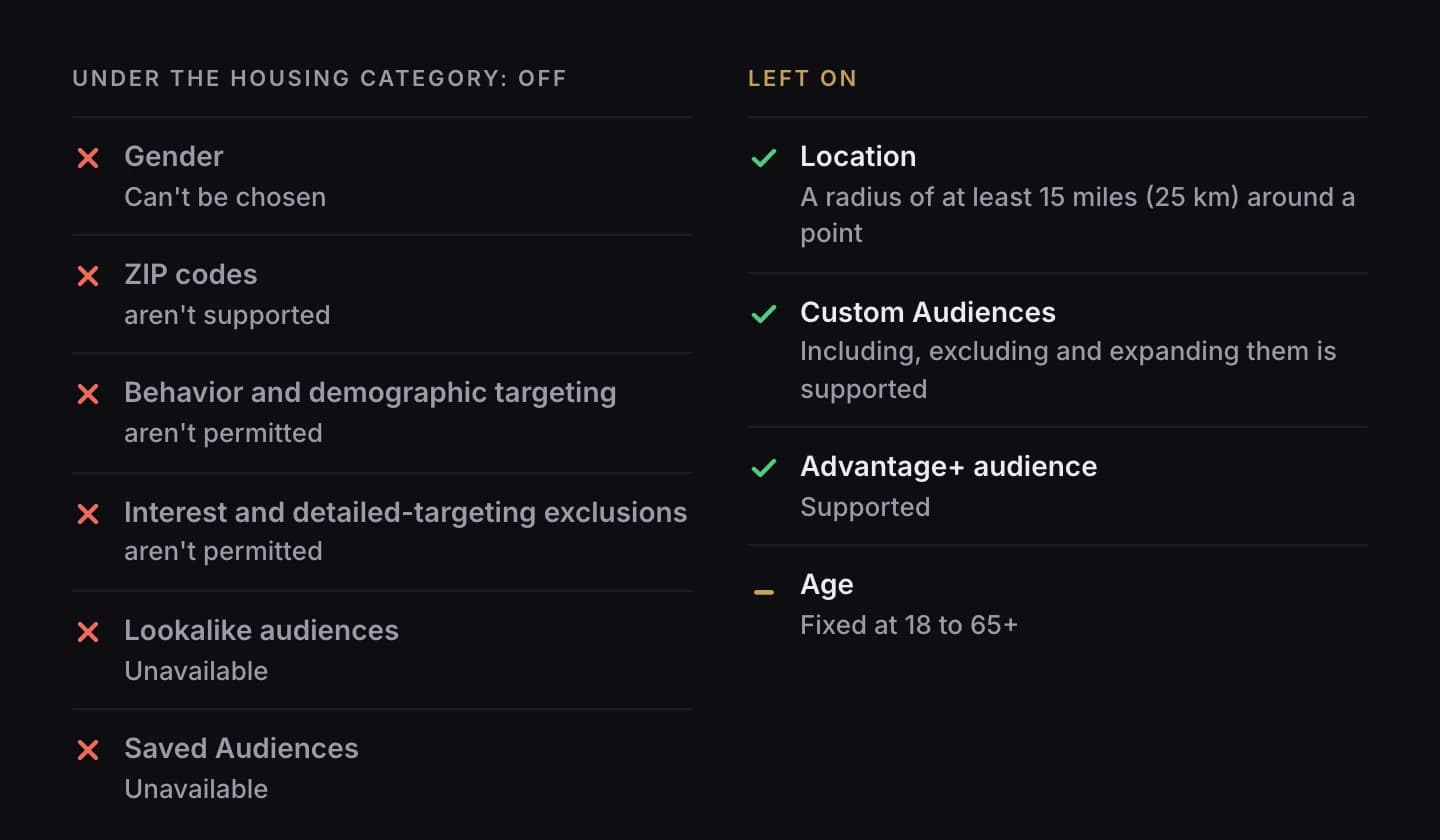
| Setting | Under the Housing category (US) |
|---|---|
| Age | Fixed at 18 to 65+ |
| Gender | Can't be chosen |
| Location | A radius of at least 15 miles (25 km) around a point; ZIP codes aren't supported; locations can't be excluded |
| Detailed targeting | Behavior and demographic targeting aren't permitted; interests only from a list Meta has approved for these categories |
| Exclusions | Interest and detailed-targeting exclusions aren't permitted |
| Lookalike audiences | Unavailable |
| Saved Audiences | Unavailable |
| Custom Audiences | Including, excluding and expanding them is supported |
| Advantage+ audience | Supported |
Two things in that table catch people out. First, the 15-mile minimum: a downtown community can't draw a one-mile circle around its block. Second, Custom Audiences still work, but they aren't a back door. Meta's policy prohibits using audience selection to wrongfully exclude groups, and so does the Fair Housing Act. Use them for people who have already shown interest in your community, not to shape who is allowed to see the ad.
How do you set up a housing ad on Facebook and Instagram?
Declare the category first, then build everything else inside it. The order matters, because the category decides which settings you're offered.
- Create the campaign and choose Housing as the Special Ad Category before anything else. If you build through Meta's API, the same campaign also needs a special ad category country, such as the US.
- Set the location as a radius of 15 miles or more around the community, or as the city or metro area your renters come from.
- Leave the audience broad. Turn on Advantage+ audience, and add a Custom Audience only where you built it from your own sources and have a clear reason to use it.
- Write the ad about the home. The floor plan, the light, the amenities, the commute, the move-in date. Never the kind of person you imagine living there (more on that below).
- Add the Equal Housing Opportunity logo or slogan to the image, video end card or text. The National Fair Housing Alliance recommends it on every ad.
- Have a person approve it before it spends anything.
Can apartment ads use Facebook lead forms?
Yes, but some questions are off-limits on housing forms. Meta publishes a help page titled "Questions Prohibited on Your Instant Form". Read it before you add custom questions. The simplest form is the safest one: name, email, phone and when the person wants to move.
Will other people see your housing ads?
Assume yes. Meta's Ad Library API lists housing ads as their own type: its HOUSING_ADS value "returns housing or real estate ads". Competitors, advocates and regulators can look at what you're running, so write every ad as if it will be read by someone who isn't a renter.
What should the ad itself do, if targeting can't?
Carry the specifics. With a broad, mixed audience, the people who should respond are the ones who recognize the home they want. Generic lines like "luxury living awaits" give them nothing to recognize.
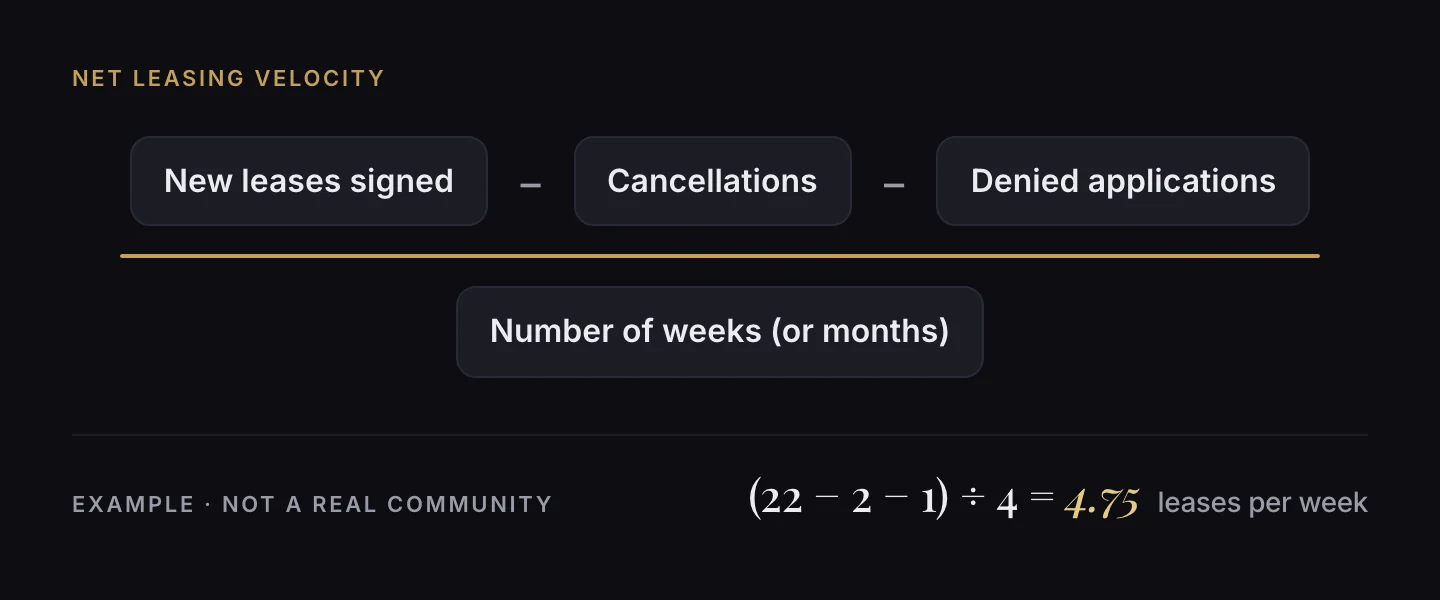
- Lead with the home that's available. If three-bedrooms are what you need to lease, show a three-bedroom: the plan, the rooms, the date it's ready. Our guide to leasing velocity covers why the slow floor plan should get the spend.
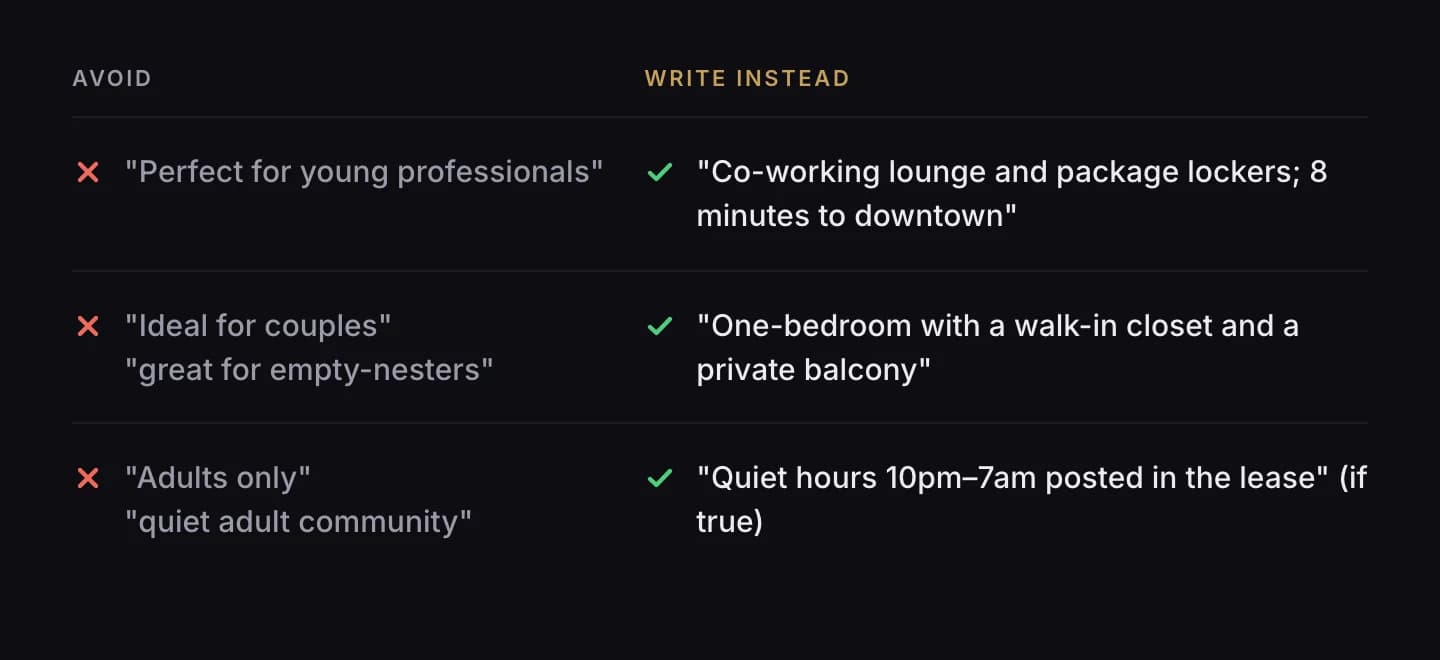
- Name the place, not the people. "Eight minutes to downtown on the 12 bus" helps a renter decide. "Perfect for young professionals" tells some renters they aren't wanted, and it's the kind of phrase fair-housing complaints are built on.
- State the offer only if it's true and say when it ends.
- Use real photos of the community. Photos and illustrations count under §100.75 too, so look at the people in your images as a set, not one ad at a time. Our 36 apartment social media post ideas work as ad creative as well.
What are the most common housing-ad mistakes?
- Not declaring the category. Every campaign that advertises homes needs it, boosted posts included.
- Copy that describes a resident. "Perfect for young professionals" and "great for families" both describe people. Describe the apartment instead. Our fair housing rules guide has a table of phrases and rewrites.
- A ZIP-code list. It isn't supported; use a radius or a city.
- Using exclusions to narrow the audience. If the point of an exclusion is to keep a group from seeing the ad, don't add it.
- Trusting the platform to catch it. Meta's rules limit the targeting. They don't check whether your words or pictures signal a preference. That part is yours.
How Lease Velocity handles housing ads
Lease Velocity is AI marketing for apartment communities. Meta and Google ads are drafted from your community's own data, inside Fair Housing rules. Every Meta campaign Lease Velocity runs is declared under the Housing category. Paid campaigns spend nothing until you approve them.
This is general information, not legal advice; check your state and local rules.
Sources (fetched 2026-10-12)
- Meta for Developers, "Special Ad Category" (Marketing API).
- Meta Transparency Center, "Discriminatory Practices" (advertising standards).
- Meta for Developers, "Ads Archive" (Graph API reference, v26.0).
- Meta Business Help Center, "Questions Prohibited on Your Instant Form" (title read; the page body did not load for this lane, so its list is not summarized here).
- Meta AI, "A new system to help ensure ads are delivered fairly to different demographic groups", January 9, 2023.
- U.S. Department of Justice, Civil Rights Division, United States v. Meta Platforms, Inc. (S.D.N.Y.) (fetched 2026-10-07).
- 24 CFR §100.75, Legal Information Institute, Cornell (fetched 2026-10-07).
- National Fair Housing Alliance, "Responsible Advertising" (fetched 2026-10-07).
Related
Lease Velocity