Fair Housing Rules for Apartment Ads and Social Posts (2026)

Contents
The Fair Housing Act makes it unlawful to publish any housing ad or statement that indicates a preference, limitation or discrimination based on a protected class, and that includes Instagram posts, Facebook ads and listing copy. The rule itself hasn't changed in 2026. What changed is that HUD withdrew its 2024 guidance on digital advertising, which leaves the statute, HUD's regulation and the ad platforms' own rules as the guardrails.
This guide covers what that means for the words, pictures and targeting an apartment community uses.
What does the Fair Housing Act say about advertising?
Section 804(c) of the Fair Housing Act, codified at 42 U.S.C. §3604(c), makes it unlawful to "make, print, or publish, or cause to be made, printed, or published" any notice, statement or advertisement about renting a dwelling that indicates a preference, limitation or discrimination based on a protected class. It also covers stating an intention to make any such preference.
HUD's regulation, 24 CFR §100.75, spells out what that covers:
- Every format. The rule reaches "all written or oral notices or statements" by a person renting a dwelling. The regulation lists flyers, brochures, signs, banners and billboards, and the logic applies equally to posts, captions and ads.
- Words and images. It names "words, phrases, photographs, illustrations, symbols or forms" that convey a home is or isn't available to a particular group.
- Where you advertise. It also covers selecting advertising media or locations in a way that denies "particular segments of the housing market information about housing opportunities."
Which groups are protected?
Federally, seven: race, color, religion, sex, disability (the statute says "handicap"), familial status (households with children under 18) and national origin. Many states and cities add more, such as source of income, age, marital status, sexual orientation or gender identity. Your ads have to satisfy the strictest rule that applies to the property's location.
Source of income deserves special attention. The Poverty & Race Research Action Council keeps a running list of state and local source-of-income laws; its March 2026 update says "over 57%" of voucher holders are now covered by such laws. Where those laws apply, "No Section 8" in an ad states a limitation on its face.
Do these rules apply to Instagram, Facebook and TikTok posts?
Yes, when the post promotes renting homes. The statute covers any "notice, statement, or advertisement" about renting a dwelling, and the regulation says the format doesn't matter. A Reel showing an available two-bedroom is advertising, a caption is a statement, and a boosted post is an ad. The platform you publish on doesn't change the rule. It only adds its own rules on top (see targeting below).
What changed for fair housing advertising in 2025 and 2026?
HUD withdrew its April 29, 2024 guidance on applying the Fair Housing Act to advertising through digital platforms. The withdrawal was effective September 17, 2025 and was announced in a Federal Register notice published April 6, 2026. The same notice withdrew seven other fair-housing guidance documents, including a February 2024 memo on source-of-income testing and 2022 guidance on criminal records. HUD says the withdrawn documents "should not be relied upon as authoritative."
What did not change:
- The statute and the regulation still apply. The withdrawal notice itself says that "any actions that do not comply with the text of the Fair Housing Act continue to be subject to enforcement by the Department."
- People can still sue. The notice also points out that complainants can file a civil action in federal or state court within two years of the alleged discriminatory practice.
- The platforms' rules still apply (see targeting below).
Withdrawn guidance means fewer official examples to lean on, not a looser law. Keep a written, consistent standard of your own.
Which words and phrases should apartment ads avoid?
Describe the home, the amenities and the location; never describe the kind of person you imagine living there. Phrases that describe a resident tend to signal a preference for one group, which is what §100.75 prohibits.
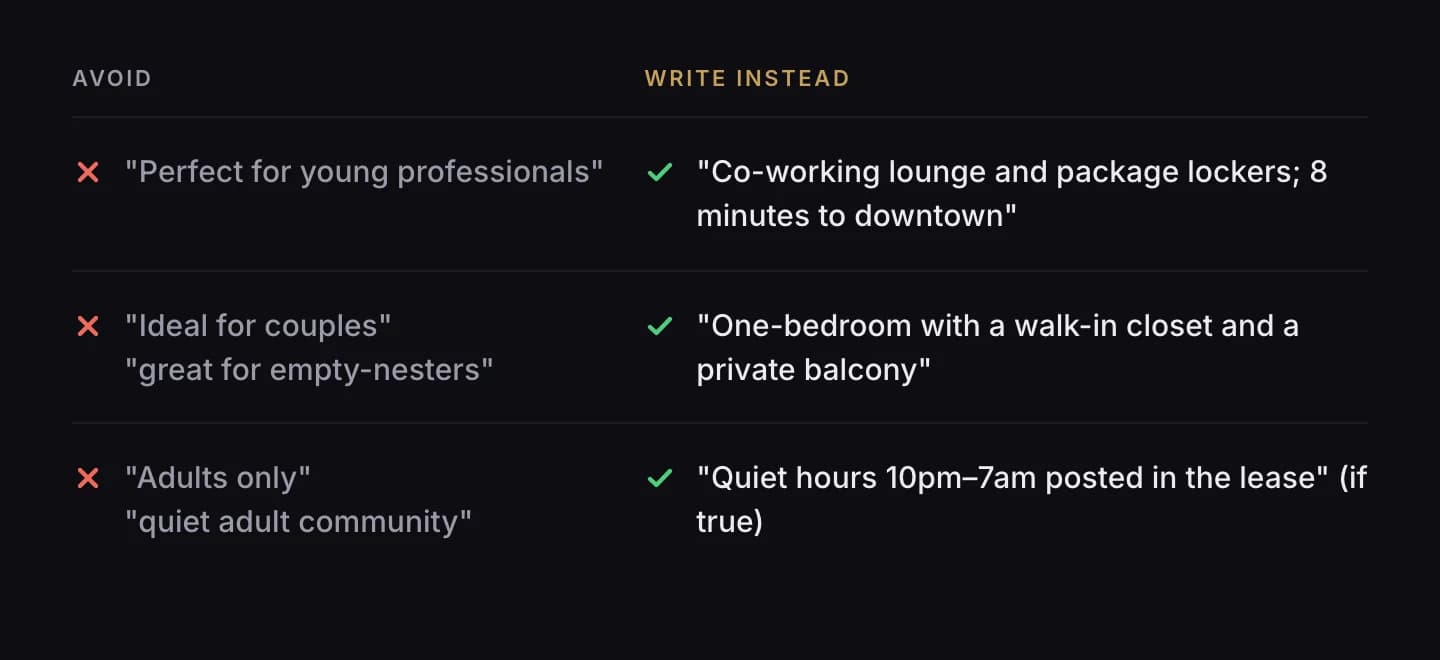
| ✕ Avoid | Why it's risky | ✓ Write instead |
|---|---|---|
| "Perfect for young professionals" | Signals an age and familial-status preference | "Co-working lounge and package lockers; 8 minutes to downtown" |
| "Ideal for couples" / "great for empty-nesters" | Familial status, marital status where protected | "One-bedroom with a walk-in closet and a private balcony" |
| "Adults only" / "quiet adult community" | Familial status (unless the property qualifies as housing for older persons under the Act) | "Quiet hours 10pm–7am posted in the lease" (if true) |
| "No Section 8" / "no vouchers" | Source of income, where state or local law protects it | Leave payment sources out, or state your actual screening criteria |
| "Walking distance to [a named church]" as a selling point | Can signal a religious preference | "Walking distance to downtown, the farmers market and the 12 bus" |
| "Exclusive" / "private community" | Can signal exclusion | "Gated entry and controlled-access garage" |
| "Able-bodied" / "must climb stairs" | Disability | "Third-floor walk-up; no elevator" (describes the building) |
Ordinary real estate words are fine when they describe the property: "family room", "walk-in closet", "wheelchair accessible", "pet-friendly". The legal test is whether the ad as a whole indicates a preference or limitation, not whether a single word appears on a list.
What about the people in apartment photos and videos?
Photos and video count as much as words. §100.75(c)(1) names "photographs" and "illustrations" explicitly. If every person across your posts reads as one age, one race or one household type, the set can signal who is welcome, even when each image on its own looks fine.
HUD's old advertising guidelines (formerly 24 CFR Part 109, which addressed human models) were removed from the Code of Federal Regulations in 1996. HUD said at the time it would provide that kind of nonbinding guidance through handbooks and other materials instead. The National Fair Housing Alliance's current advice is simple: if you feature models, "ensure that the images are inclusive and representative of all communities that need access to housing."
In practice:
- Prefer photos of the homes and amenities themselves.
- When people appear, vary them across the month's posts, not just within one image.
- Get written permission from any resident or employee you feature.
- Be careful with AI-generated people: image models drift toward one look, so check the whole set before you publish.
Do apartment ads need the Equal Housing Opportunity logo?
The National Fair Housing Alliance recommends it in every ad: "Always include the fair housing logo and/or the 'Equal Housing Opportunity' slogan." HUD provides the official artwork for download on its Equal Housing Opportunity graphics page. Whether it's mandatory for your property can depend on your financing, any HUD programs you participate in, and state law. Including it costs nothing, so most communities put it on every ad and on the closing frame of every video.
What are the ad-targeting rules on Meta and Google?
Both platforms remove the targeting options that could be used to exclude protected groups, so you target by geography and let the creative do the work.
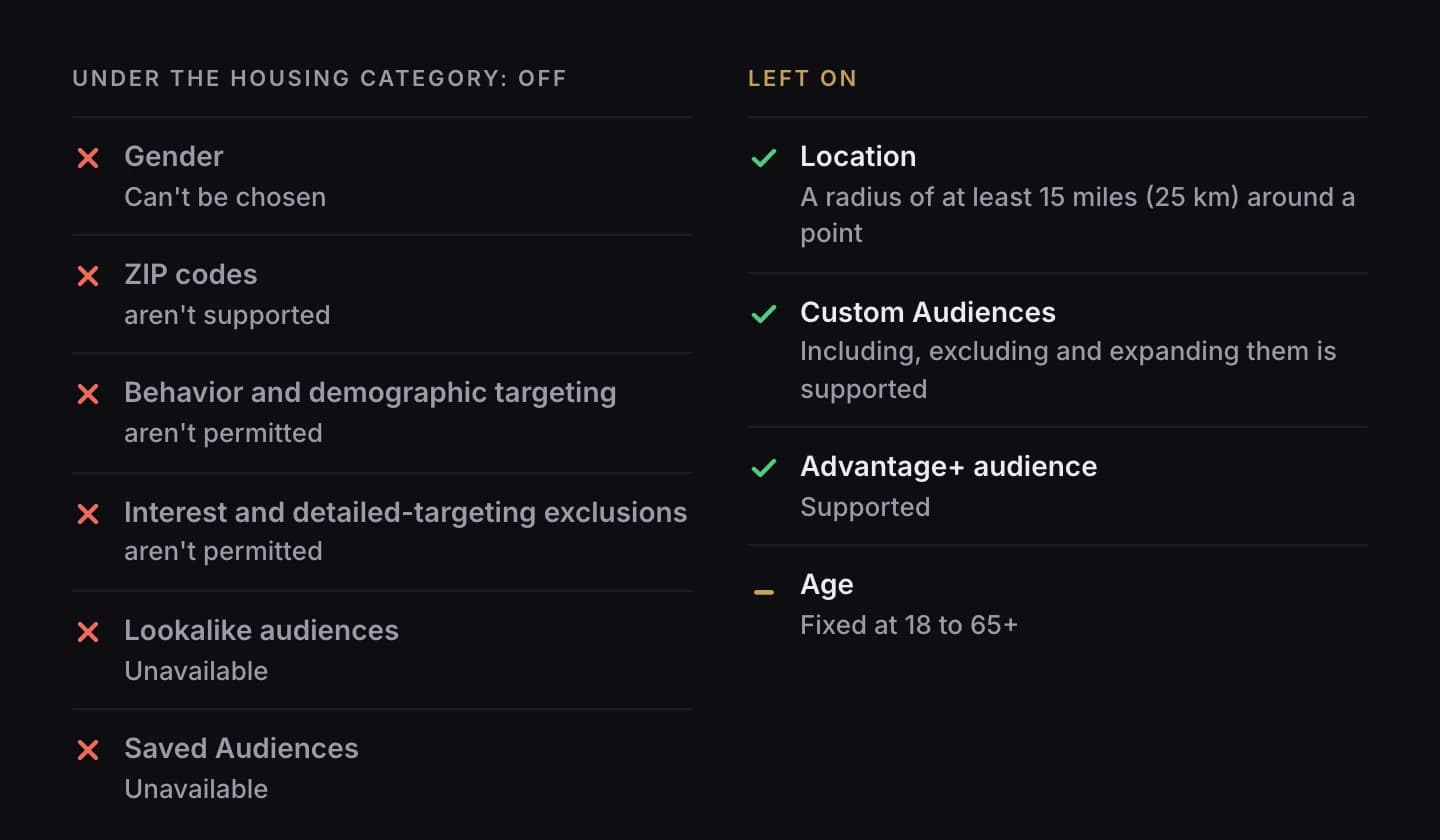
Meta (Facebook and Instagram). Housing ads must be declared under Meta's Special Ad Category. Per Meta's developer documentation:
- age is "generally fixed to include ages 18 through 65+";
- a specific gender "cannot be chosen";
- location must cover at least a "15 mile or 25 kilometer radius" in the US and Canada, and ZIP-code targeting isn't supported;
- lookalike audiences are unavailable;
- detailed-targeting exclusions are not allowed.
These rules have a history. In United States v. Meta Platforms, the Justice Department alleged Meta's ad system discriminated in delivering housing ads. In the settlement approved June 27, 2022, Meta agreed to stop using its "Special Ad Audience" tool for housing and to build a Variance Reduction System for housing ad delivery.
Google. Google's housing ads policy for the US and Canada:
- requires age, gender and parental status to stay enabled, so you can't exclude by them;
- restricts marital-status and ZIP-code targeting;
- lets you use city, state or radius targeting instead.
Your own media choices count too. §100.75(c)(3) covers choosing media or locations that keep "particular segments of the housing market" from learning about your homes. Spread your spend across the channels renters in your market actually use.
Does the law apply to AI-written ads and posts?
Yes. The law doesn't care who or what drafted the words. The statute covers anyone who will "make, print, or publish, or cause to be made, printed, or published" a discriminatory ad. If an AI tool writes "perfect for young professionals" and your community publishes it, your community published it.
That makes three habits worth building into any AI-assisted marketing:
- A human approves every post and ad before it goes out.
- Every draft gets a fair-housing check that flags risky phrases and explains why, rather than silently rewriting them, so the person approving learns the pattern.
- Images get reviewed as a set, not one at a time (see the photo section above).
A fair-housing checklist for every post and ad
- The copy describes the home, amenities and location, not a type of resident.
- No phrase limits or prefers a protected group, including state and local classes such as source of income.
- The people shown, across this month's posts, aren't all one age, race or household type.
- Every featured resident or employee gave written permission.
- The Equal Housing Opportunity logo or slogan appears on ads and on video closing frames.
- Paid housing ads are declared under Meta's Special Ad Category / follow Google's housing policy.
- A person approved it before it published.
How Lease Velocity handles this
Lease Velocity is AI marketing for apartment communities. A generated post is a draft until you approve it, and only an approved post with a time on it ever publishes. Paid campaigns spend nothing until you approve them.
For more on what to post, see our 36 apartment social media post ideas. For why paid reach matters to your lease-up, see what leasing velocity is and how to raise it.
This is general information, not legal advice; check your state and local rules.
Sources (fetched 2026-10-07)
- 42 U.S.C. §3604 (Legal Information Institute, Cornell).
- 42 U.S.C. §3602 (definitions) and §3607 (housing for older persons), Legal Information Institute, Cornell.
- 24 CFR §100.75 (Legal Information Institute, Cornell).
- HUD, "Notification of Withdrawal of Fair Housing and Equal Opportunity Guidance Documents", Docket FR-6571-N-01, Federal Register, published April 6, 2026; withdrawal effective September 17, 2025.
- HUD final rule removing 24 CFR Parts 106 and 109, 61 FR (April 1, 1996), FR Doc. 96-7786, effective May 1, 1996.
- U.S. Department of Justice, Civil Rights Division, United States v. Meta Platforms, Inc. (S.D.N.Y.).
- Meta for Developers, "Special Ad Category".
- Google Ads Help, housing ads targeting policy (US and Canada).
- HUD, Equal Housing Opportunity graphics for printing.
- National Fair Housing Alliance, "Responsible Advertising".
- Poverty & Race Research Action Council, "State and Local Source-of-Income Nondiscrimination Laws" (updated March 2026).
Related
Lease Velocity